Jiye Performance Men's Women's Shoes Fashion Basketball Sneaker Price
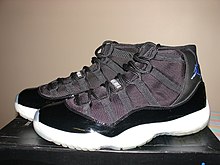

A pair of traditional low-cut Converse sneakers
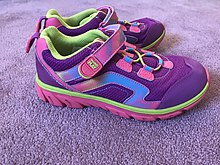
Sneakers (likewise called trainers, athletic shoes, tennis shoes, gym shoes, kicks, sport shoes, flats, running shoes, or runners) are shoes primarily designed for sports or other forms of physical exercise, simply which are at present also widely used for everyday casual wear.
Since their popularization by companies such as Converse, Nike and Spalding in the mid 20th century, they have become attire, with variety growing in many global markets exponentially. Like other parts of the global clothing industry, manufacture of shoes is heavily concentrated in Asia with nine in ten shoes produced in that region.[ane]
Gimmicky sneakers are largely fabricated from constructed materials, and the materials and manufacturing process produce, on average, about 14 kg (31 lb) of COtwo emissions.[ii] [3] Some companies are trying to substitute more sustainable materials in their manufacture.[iii] Virtually 90% of shoes cease up in landfills at end of life.[iv]
Names and etymology
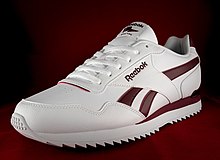
Reebok Majestic Glide Ripple Prune men's shoe
The shoes have gone by a variety of names, depending on geography and changing over the decades. The term "sneakers" is about normally used in Northeastern United States, Central and South Florida,[5] [6] New Zealand, and parts of Canada. However, in Australian, Canadian, and Scottish English, running shoes and runners are synonymous terms used to refer to sneakers; with the latter term as well used in Hiberno-English. Tennis shoes is another term used in Australian, and North American English.
The British English language equivalent of sneaker in its modernistic form is divided into 2 separate types - predominantly outdoor and fashionable trainers, training shoes or quality 'basketball shoes' and in contrast cheap rubber-soled, low cut and canvas-topped 'plimsolls'. In Geordie English, sneakers may also be chosen sandshoes, gym boots, or joggers;[7] while plimsolls may exist referred to every bit daps in Welsh English.
Several terms for sneakers be in South Africa, including gym shoes, tennies, sports shoes, sneaks, and takkies.[8] Other names for sneakers includes rubber shoes in Philippine English, track shoes in Singapore English, canvas shoes in Nigerian English, Camboo in Republic of ghana English meaning Camp kick and sportex in Greece.
Plimsolls (British English language) are "low-tech" athletic shoes and are also called "sneakers" in American English. The discussion "sneaker" is often attributed to American Henry Nelson McKinney, who was an advertising agent for N. Westward. Ayer & Son. In 1917, he used the term because the safety sole fabricated the shoe's wearer stealthy. The word was already in use at least as early as 1887, when the Boston Journal fabricated reference to "sneakers" as "the name boys give to lawn tennis shoes." The proper name "sneakers" originally referred to how quiet the rubber soles were on the ground, in dissimilarity to noisy standard hard leather sole dress shoes. Someone wearing sneakers could "sneak up", while someone wearing standards could non.[9]
Before, the name "sneaks" had been used by prison house inmates to refer to warders because of the rubber-soled shoes they wore.[x]
History

Keds Champion sneaker, for women, 1916
These shoes acquired the nickname 'plimsoll' in the 1870s, derived according to Nicholette Jones' book The Plimsoll Sensation, from the colored horizontal band joining the upper to the sole, which resembled the Plimsoll line on a ship's hull. Alternatively, just similar the Plimsoll line on a ship, if water got above the line of the prophylactic sole, the wearer would get moisture.[xi]
Plimsolls were widely worn by vacationers and also began to be worn by sportsmen on the tennis and croquet courts for their comfort. Special soles with engraved patterns to increment the surface grip of the shoe were adult, and these were ordered in bulk for the use of the British Army. Athletic shoes were increasingly used for leisure and outdoor activities at the turn of the 20th century - plimsolls were fifty-fifty constitute with the ill-fated Scott Antarctic expedition of 1911. Plimsolls were commonly worn past pupils in schools' concrete education lessons in the UK from the 1950s until the early 1970s.[ commendation needed ]
British company J.West. Foster and Sons designed and produced the first shoes designed for running in 1895; the shoes were spiked to allow for greater traction and speed. The company sold its high-quality handmade running shoes to athletes around the world, eventually receiving a contract for the manufacture of running shoes for the British team in the 1924 Summer Olympics. Harold Abrahams and Eric Liddell won the 100 m and 400 m events, kitted out with Foster'south running gear.[12]
This fashion of footwear likewise became prominent in America at the turn of the 20th century, where they were called 'sneakers'. In 1892, the U.S. Safety Company introduced the first rubber-soled shoes in the land, sparking a surge in demand and production. The showtime basketball shoes were designed past Spalding as early as 1907.[ citation needed ] The market for sneakers grew after World War I, when sports and athletics increasingly became a way to demonstrate moral fiber and patriotism. The U.S. market for sneakers grew steadily as young boys lined up to buy sneakers endorsed by football player Jim Thorpe and Converse All Stars endorsed by basketball player Chuck Taylor.
During the interwar period, athletic shoes began to be marketed for unlike sports, and differentiated designs were made available for men. Athletic shoes were used by competing athletes at the Olympics, helping to popularise able-bodied shoes among the general public. In 1936, a French brand, Spring Courtroom,[13] marketed the first canvas lawn tennis shoe featuring signature eight ventilation channels on a vulcanised natural rubber sole.
Adolf "Adi" Dassler began producing his own sports shoes in his female parent's wash kitchen in Herzogenaurach, Bavaria, afterward his render from World War I, and went on to establish one of the leading athletic shoe manufacturers, Adidas.[14] He too successfully marketed his shoes to athletes at the 1936 Summer Olympics, which helped cement his good reputation. Business boomed and the Dasslers were selling 200,000 pairs of shoes each year before Earth War 2.[15] [16]
Post-War

A large pile of athletic shoes for sale at a market in Hong Kong
During the 1950s, leisure opportunities greatly expanded, and children and adolescents began to wear sneakers equally schoolhouse dress codes relaxed. Sneaker sales rose so high, they began to adversely affect the sales of conventional leather shoes, leading to a fierce ad state of war for market share in the late '50s. In the 1970s, jogging for exercise became increasingly popular, and trainers designed specifically for comfort while jogging sold well. Companies also started to target some of their products at the casual fashion market. Soon, shoes were available for football, jogging, basketball game, running, etc. Many sports had their relevant shoe, made possible past podiatrist development of athletic shoe technology.
During the 1990s, shoe companies perfected their fashion and marketing skills. Sports endorsements with famous athletes grew larger, and marketing budgets went through the roof. Sneakers became a fashion statement and were marketed equally a definition of identity and personality rather than simply athletic aids.[17]
From 1970 (five models), to 1998 (285 models), to 2012 (3,371), the number of sport shoe models in the U.S. has grown exponentially.[18]
Use in sports
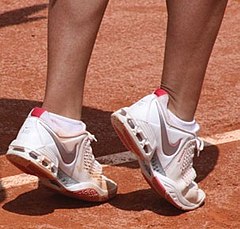
A pair of modernistic Nike all-purpose athletic shoes
The term 'athletic shoes' is typically used for shoes utilized for jogging or road running and indoor sports such equally basketball, only tends to exclude shoes for sports played on grass such as association football and rugby football, which are more often than not known in North America equally "cleats" and in British English language every bit "boots" or "studs".
Attributes of an athletic shoe include a flexible sole, appropriate tread for the function, and ability to blot affect. Every bit the industry and designs have expanded, the term "able-bodied shoes" is based more on the design of the bottom of the shoe than the aesthetics of the meridian of the shoe. Today's designs include sandals, Mary Janes, and even elevated styles suitable for running, dancing, and jumping.
The shoes themselves are made of flexible compounds, typically featuring a sole fabricated of dense rubber. While the original design was basic, manufacturers accept since tailored athletic shoes for their specific purposes. An example of this is the spiked shoe developed for rails running. Some of these shoes are fabricated up to unusually large sizes for athletes with large feet.
Running shoes
Running shoes come in a range of shapes suited to dissimilar running styles/abilities. Generally, they are divided by running style: the bulk are for heel-toe joggers/runners which are farther subdivided into 'neutral', 'overpronation' and 'underpronation'.[19] [20] These are constructed with a complex structure of "rubber" with plastic/metal stiffeners to restrict pes movement. More avant-garde runners tend to wearable flatter and flexible shoes, which permit them to run more quickly with greater condolement.
According to the NPD Grouping, one in four pairs of running shoes that were sold in the United States in 2016 were bought from an online retailer.[21]
Notable brands
Equally of 2020[update], brands with global popularity include:
- 361°
- Adidas
- Allbirds
- Anta
- ASICS
- Babolat
- Brooks
- Antipodal
- DC
- Diadora
- Dunlop
- Ethletic
- Feiyue
- Fila
- Hoka One One
- Hummel
- Hurley International
- Kappa
- Karhu
- K-Swiss
- Keds
- Li-Ning
- Lotto
- Merrell
- Mizuno
- New Balance
- Nike
- On
- Onitsuka Tiger
- PF Flyers
- Pony
- Pro-Keds
- Puma
- Reebok
- Salomon
- Saucony
- Skechers
- Pace Rite
- Tisza Cipő
- Umbro
- Nether Armour
- Vans
- World Residuum
- Xtep
- Supra
Types and number of models
- High-tops cover the talocrural joint.
- Low-tops or oxfords do non encompass the ankle.
- Mid-cutting sneakers are in-between high-tops and depression-tops.
- Sneaker boots extend to the calf.
- Slip-ons like low-tops/oxfords practice not cover the ankle and do non take laces.
- Low-superlative CVO (Circular Vamp Oxford) similar low-tops exercise not cover the talocrural joint but unlike low-tops accept a vamp in a circular form and typically four to five eyelets.
- Loftier-superlative CVO (Circular Vamp Oxford) like high-tops encompass the ankle and also have a round vamp.
Culture

Sneakers have been an important part of hip hop (primarily Pumas, Nike, and Adidas) and rock 'n roll (Converse, Vans) cultures since the 1970s. Hip hop artists sign million dollar deals with major brands such equally Nike, Adidas, or Puma to promote their shoes.[22] [ commendation needed ] Sneaker collectors, called "sneakerheads", regard sneakers as fashionable items. Sneaker companies encourage this trend past producing rare sneakers in limited numbers, oft at very loftier retail prices. Artistically-modified sneakers can sell for up of $1000 at sectional establishments like Saks 5th Avenue.[23] In 2005, a documentary, Just for Kicks, about the sneaker phenomenon and history was released.[24] [ citation needed ]
Run across as well
- Biodegradable athletic footwear
- Comparison of orthotics
- List of shoe styles
References
- ^ Footwear, World. "Global Footwear Industry: Positive Dynamics in 2018". Earth Footwear . Retrieved 2020-07-30 .
- ^ Cheah, Lynette; Ciceri, Natalia Duque; Olivetti, Elsa; Matsumura, Seiko; Forterre, Dai; Roth, Richard; Kirchain, Randolph (2013-04-01). "Manufacturing-focused emissions reductions in footwear production". Journal of Cleaner Production. 44: 18–29. doi:x.1016/j.jclepro.2012.eleven.037. hdl:1721.one/102070. ISSN 0959-6526.
- ^ a b "Are Eco-Runners The Next 'It' Trainer?". British Vogue. 21 Oct 2019. Retrieved 2021-02-nineteen .
- ^ Hoskins, Tansy E. (2020-03-21). "'Some soles last ane,000 years in landfill': the truth about the sneaker mountain". The Guardian . Retrieved 2021-02-19 .
- ^ Katz, Josh (25 Oct 2016). Speaking American: How Yous, Youse, and You Guys Talk: A Visual Guide. Houghton Mifflin Harcourt. pp. 4–5. ISBN978-0544703391 . Retrieved 13 July 2017.
- ^ Hickey, Walter (5 June 2013). "22 Maps That Bear witness How Americans Speak English Totally Differently From Ane Another". Business concern Insider . Retrieved 2017-03-09 .
- ^ "Geordie Dictionary". www.englandsnortheast.co.uk . Retrieved 2017-03-09 .
- ^ Pettman, Charles (1913). Africanderisms: A Glossary of South African Colloquial Words and Phrases and of Place and Other Names. CreateSpace Contained Publishing Platform. p. 491. ISBN1515051226.
- ^ Mental Floss mag, Sept-Oct 2008
- ^ Robinson, Frederick William (1863). Female person life in prison house, by a prison house matron. Hurst and Blackett. ISBN9781341245022.
- ^ Susie Paring (2011). How to Talk Like a Local: From Cockney to Geordie. Random Firm. p. 99. ISBN9781409061953.
- ^ Foster, Rachael. "Foster'due south Famous Shoes". Bolton Revisited . Retrieved xv Oct 2015.
- ^ "Running Shoes for Plantar Fasciitis Men & Women". Your Comfortable Feet. Retrieved xv October 2015.
- ^ Smit, Barbara (2009). Sneaker Wars. New York: Harper Perennial. ISBN978-0-06-124658-6.
- ^ "Exploring the History of Basketball game Shoes". Sports Domain Lab. xviii March 2019.
- ^ "How Adidas and PUMA were born". in.rediff.com. 8 November 2005. Retrieved 26 September 2010.
- ^ Pribut, Stephen M. "A Sneaker Odyssey". Dr. Stephen K. Pribut's Sport Pages. 2002. Spider web. 23 June 2010.
- ^ Aichner, T. and Coletti, P. 2013. "Customers' online shopping preferences in mass customization". Journal of Direct, Data and Digital Marketing Practice, 15(1): 20-35.
- ^ "Understand pronation to go the right running shoes". Comfort Hacks . Retrieved 14 October 2015.
- ^ Marius Bakken. "Fitting Your Running Shoes to Your Feet". Retrieved 2009-04-24 .
- ^ Chesto, Jon (2017-07-19). "New City Sports owners plot revival of Boston brand". The Boston World. Archived from the original on 2017-07-21. Retrieved 2017-07-20 .
- ^ Belzer, Jason. "Sneaker Wars: Kanye W Signs Deal with Adidas, Drake with Jordan Brand". Forbes . Retrieved 2016-01-28 .
- ^ 2014 Saks Fifth Avenue catalog
- ^ History of Sneakers http://theidleman.com/history-of-sneakers
External links
-
 Media related to Sneakers (footwear) at Wikimedia Commons
0 Response to "Jiye Performance Men's Women's Shoes Fashion Basketball Sneaker Price"
Post a Comment